I help enterprises build AI systems that pass production scrutiny, not just demos — through structured assurance, outcome-based QE transformation, and the governance infrastructure boards can rely on.
I have navigated this shift firsthand across $350M+ in delivery portfolios. What follows is what the transition actually looks like in practice — not the playbook I am about to write, but the one I have already run.
Test as a phase — bolted on after development
Quality engineered into every stage of delivery
Manual coverage and effort-based pricing
AI-assisted autonomous validation, priced on outcomes
Tooling silos and ad-hoc AI pilots
Unified AI-QE platforms and POD-led delivery at enterprise scale
Different seat, same underlying question: is the organisation's AI-led delivery something it can actually stand behind.
AI systems are in production. The board is starting to ask hard questions about reliability, bias, and regulatory exposure — and a compliance audit or a public AI failure would be costly.
Test cycles are still slow, defect leakage persists, and the business is asking why AI hasn't translated into faster, cheaper, more reliable delivery. The operating model needs a reset — not another tool.
LLM and agentic features are moving from prototype to real users faster than the assurance discipline around them is maturing. Nobody wants to be the team that shipped the hallucination, the leak, or the jailbreak that made the news.
Each pillar can be engaged standalone or combined. Every one maps to work I have personally led and held P&L accountability for.
For teams shipping LLM features or agentic products who need to know it won't hallucinate, leak data, or fail silently in front of a customer. I build the evaluation harness, RAG testing, guardrails, and audit-ready evidence — backed by TrustQE. My approach: discover, guardrail, evaluate, govern. Delivered as a defined AI Assurance Lab engagement or an ongoing Executive Advisory Retainer. Also available as a short AI / eval-maturity diligence engagement for funds evaluating an AI-native investment or acquisition.
For organisations that need senior QE leadership but aren't ready for a full-time hire. An ongoing part-time seat covering operating model (team structure, governance, tooling), delivery reliability (release discipline, observability), and — for service-provider and PE-portfolio clients — AI-led QE go-to-market and analyst positioning (Forrester, NelsonHall).
For organisations whose QE practice has adopted AI tools but hasn't seen the economics move, or that are starting QE from zero. I build the function AI-native from day one — autonomous test generation, self-healing automation, AI-POD delivery, Digital QE Twins — the same approach that delivered 25–30% productivity uplift and 40%+ throughput in live enterprise programs.
Two kinds of proof below: direct AI-assurance work, and the enterprise QE-transformation track record that AI-led engagements build on. Every one has a P&L, an outcome, and a client behind it.
Conducted an AI-led QE assessment of a PE portfolio company, identified delivery risk, and piloted AI-led SDLC transformation targeting 30% productivity uplift — with a costed roadmap for scale. Now a standing engagement type: AI and eval-maturity diligence for funds ahead of an investment or acquisition decision.
Delivered unified QE governance across 15 online brands spanning global markets — release stability and automation coverage at a scale the organisation had not previously achieved.
Built an engineering platform that automated core workflows and consolidated tooling — converting fragmented, manual testing into a platform-led delivery model with measurable economic returns.
Re-engineered QE and delivery — shifted left, automated regression, embedded DevOps — achieving $1.2M+ in savings with zero production defects and 70%+ automation coverage in 18 months.
Architected the test solution for India's foundational digital identity programme — one of the highest-stakes assurance challenges in the country, connected to $800M+ in deal context.
Grew a $70M+ account portfolio by over 300% through predictable delivery, executive relationships, and a $40M+ expansion anchored in AI-led QE transformation of the client's engineering estate.
Delivery productivity uplift via AI-POD models, embedded into live enterprise programs.
Throughput gain from AI-POD operating model — measured across customer delivery portfolios.
Reduction in defect leakage — from structural shift-left and autonomous test generation.
Testers reskilled to 73% multi-skilled engineers in 15 months — utilisation lifted 68% to 85%.
Landmark AI-led portfolio wins anchored — the organisation's first independent AI-driven QE deals.
Forrester Wave & NelsonHall NEAT, Quality Engineering — from analyst briefings I led directly.
Start where it matters most for your organisation. Each path is a distinct engagement with a clear scope and a defined outcome.
A short, focused read on where your AI trust gaps actually are — before committing to anything larger. The fastest way to get a credible outside view and know what, if anything, needs to happen next.
A structured QE and AI-led delivery assessment producing a clear, costed transformation roadmap — with a target operating model and prioritised execution sequence.
A full AI-QE transformation — AI-POD delivery, autonomous test generation, Digital QE Twins, platform deployment, outcome-based commercial governance — delivered through the journey, not handed over as a document.
Ongoing part-time leadership across operating model, delivery reliability, and AI assurance strategy — as an Executive Advisory Retainer or Fractional Head of QE seat, with the P&L discipline of someone who has run the function at enterprise scale.
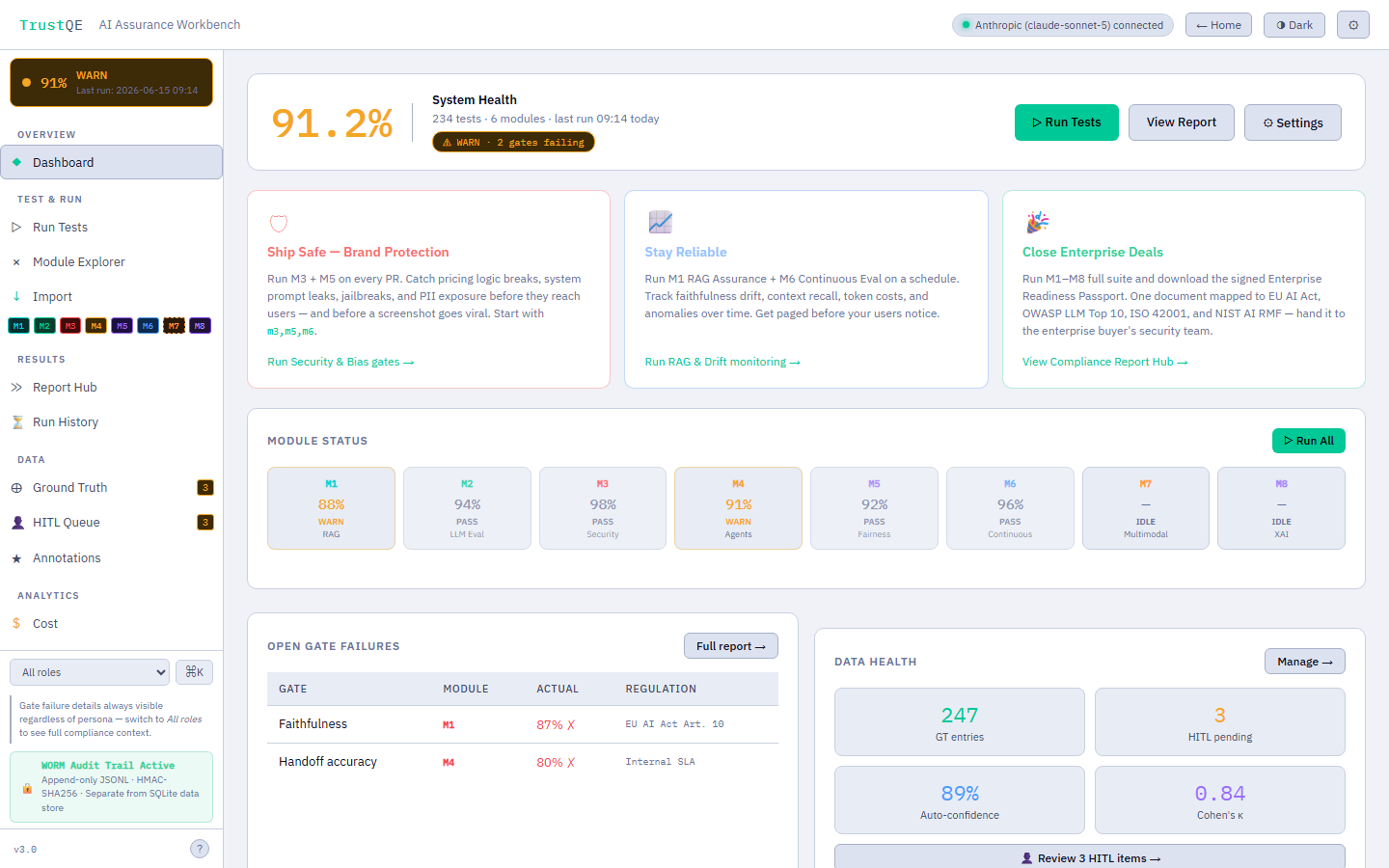
I built TrustQE to make structured AI assurance practical at enterprise scale. Eight testing modules — RAG pipelines, LLM evaluation, security vulnerabilities, agent behaviour, Responsible AI, continuous evaluation, multi-modal models, and explainability (XAI) — with Web UI, CLI, and pytest-native interfaces. Provider-agnostic. CI/CD-ready.
See the platform →Quality Engineering must become Trust Engineering — validating not just whether software works, but whether AI systems can be governed, explained, and defended.
Most AI programmes don't fail because of bad technology — they fail because the operating model and the assurance infrastructure weren't built to match. The enterprises that win in the AI era will not be the fastest to ship. They will be the most confident in what they have shipped. That confidence is engineered — not asserted.
I'm Debraj Gupta. Before advising independently, I spent 28 years in enterprise delivery leadership — most recently as Global Head of Quality Engineering at LTIMindtree and Movate Technologies, scaling a $350M+ practice to 7,500+ professionals. I led the Forrester and NelsonHall analyst briefings that produced Leader positioning in AI Assurance, anchored two $50M+ AI-led portfolio wins, and built and shipped a 20-agent AI Assurance platform into live customer programs. I now bring that operating discipline to enterprises that need their AI to be trustworthy — not just functional.
If your AI programme has a trust gap — in the board, the regulator, or the market — I can tell you within 45 minutes whether I can close it.